Most people in Indian tech have never heard of NM-ICPS: I worked inside one of its hubs and mentioned it to engineers who should know.
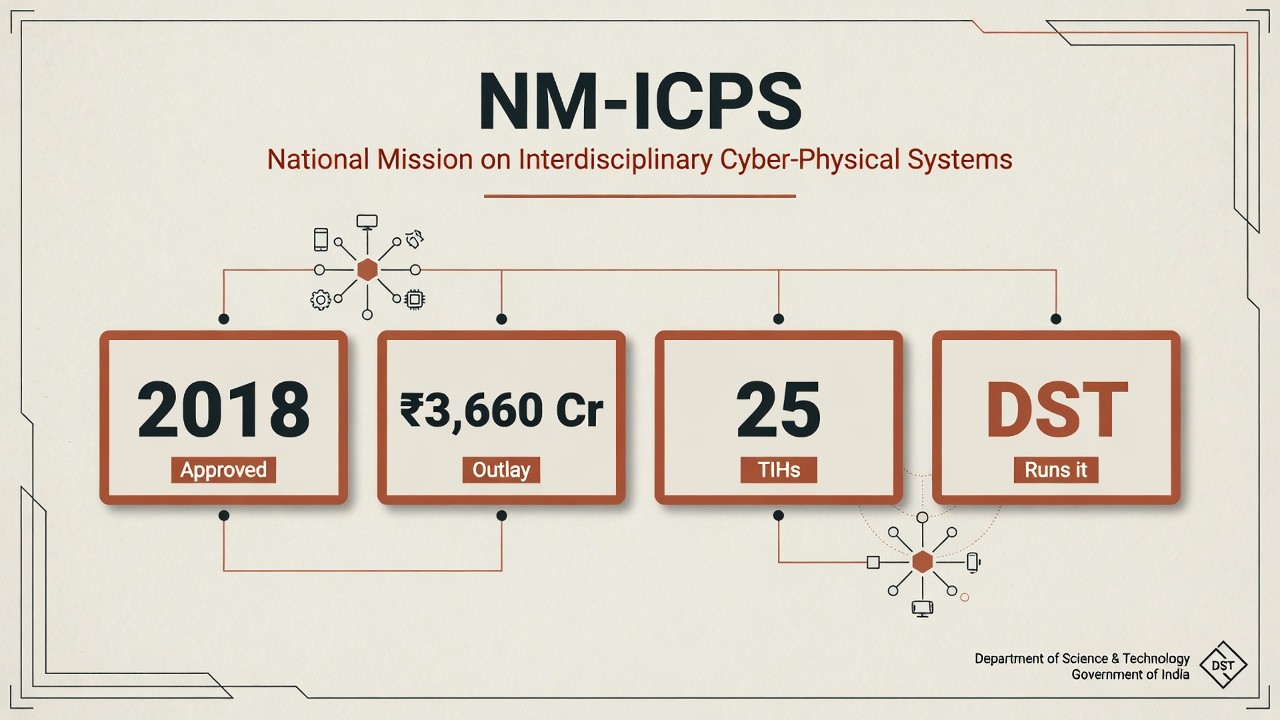
The National Mission on Interdisciplinary Cyber-Physical Systems. Cabinet approved it in December 2018. ₹3,660 crore outlay. Department of Science and Technology runs it. The idea was simple enough: put serious money into advanced technology at India's best institutes and structure the whole thing to produce startups, with papers as the side effect.
What came out of it is 25 Technology Innovation Hubs spread across IITs, IISc, IIITs, and a few others. I worked at one of them. This is what the system looks like from inside.
The 25-hub network
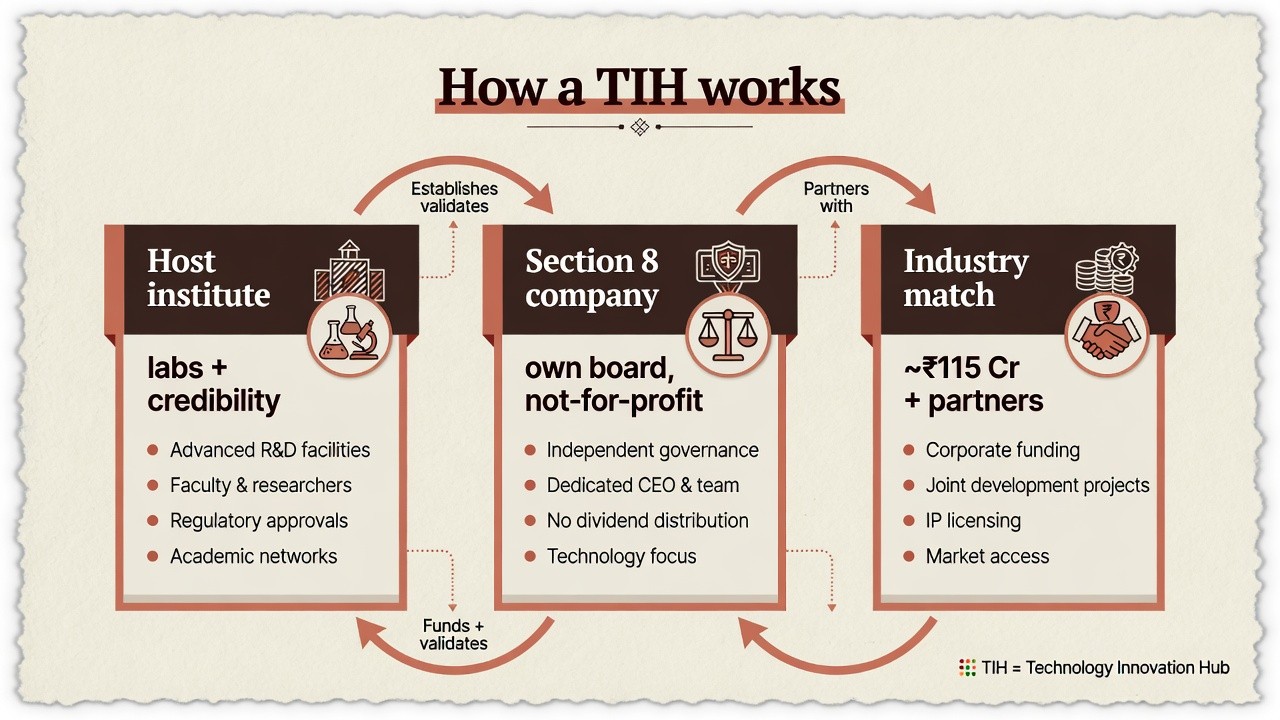
Each TIH is a Section 8 company: a not-for-profit with its own board, independent of the host institute. Roughly ₹115 crore per hub sanctioned by DST over the project period, with matching contributions expected from industry. The host institute provides the campus, the labs, the credibility.
The domains cover almost everything: robotics at IISc Bangalore, autonomous navigation at IIT Hyderabad, IoT at IIT Bombay, cybersecurity at IIT Kanpur, quantum at IISER Pune, fintech at IIT Bhilai, agritech at IIT Ropar, mining at IIT (ISM) Dhanbad. Computer vision at IIT Jodhpur. Speech and text at IIT Patna. Cobotics at IIT Delhi.
Twenty-five verticals, each attached to an institution with deep domain expertise: specialized incubators where the faculty, the labs, and the local industry already exist.
The numbers they publish are substantial. 1,146 technologies developed. 1,329 products. 1,136 startups incubated. 5,824 fellowships funded. Close to 246,000 people trained. They're spread across all 25 hubs with infrastructure behind them. The interesting part is what happens inside one of them.
TEXMiN: mining, minerals, and machines that don't break underground
I interned at TEXMiN at IIT (ISM) Dhanbad. If you're not from the mining world, IIT (ISM) doesn't register the way IIT Bombay or Madras does. But for mining and earth sciences, this place has a century of history. The campus sits in Dhanbad, India's coal capital. People die underground. Equipment fails in environments where "call support" isn't an option.
Campus, labs, and facility photos live on their site: start at texmin.in and the about page.
TEXMiN's job is to bring cyber-physical systems into that world. AI for mineral exploration. IoT for monitoring underground conditions. Drones for mine surveying. Private 5G for real-time data where traditional networks don't reach. The framing they use internally is "3S Mining": Safe, Smart, Sustainable.
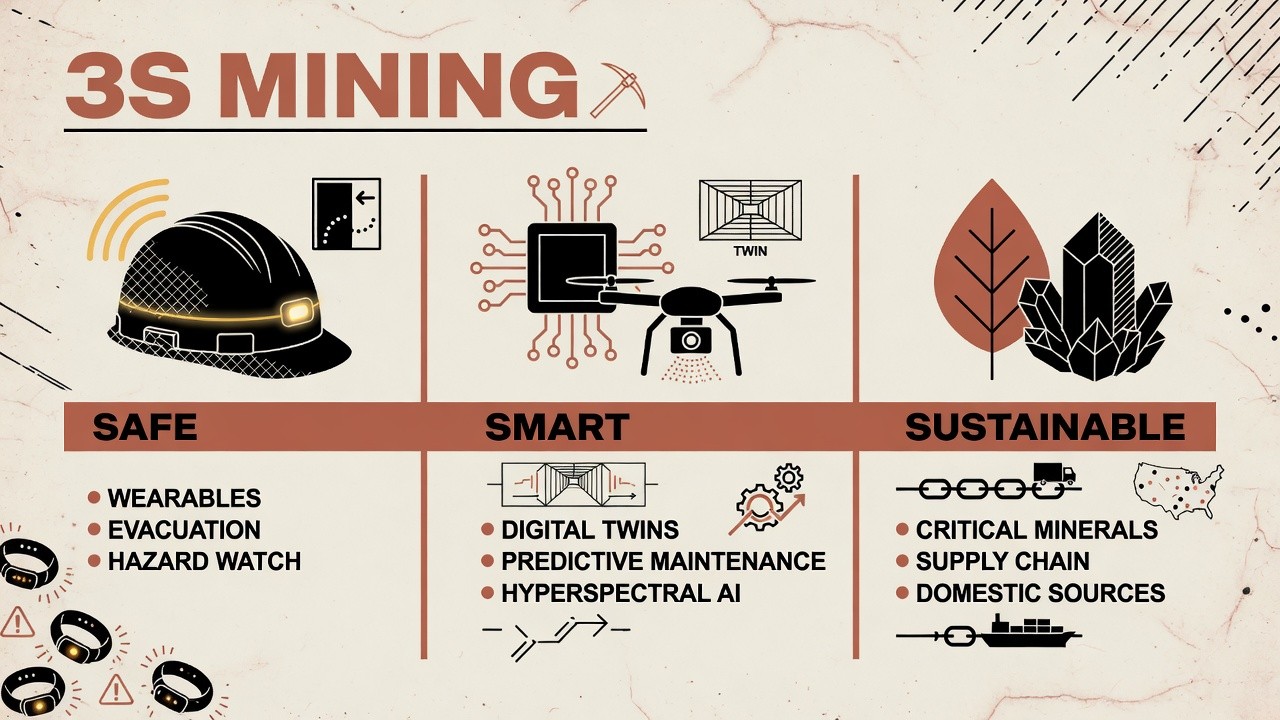
Safe means wearable devices for workers underground. Evacuation systems that work when everything else fails. Surveillance that catches hazards before they become accidents.
Smart means predictive maintenance for the giant machines that extract minerals. Digital twins of operational mines so you can simulate before you dig. AI that reads hyperspectral sensor data and tells you what minerals are in the rock.
Sustainable means tracking the supply chain for critical minerals. Rare earth elements that go into batteries and semiconductors. Finding domestic sources so India isn't dependent on China for every gram of lithium concentrate.
They built India's first private 5G-powered Digital Mining Infrastructure lab: a testbed that replicates both underground and opencast conditions so you can test equipment without going into an actual mine. There's a Sandvik automation learning centre. A Dassault Systèmes centre for digital mine planning. A geospatial lab with Esri. An Agilent lab for critical minerals testing. A FabLab for prototyping.
For lab and facility imagery, see TEXMiN's own pages rather than copies here: texmin.in · about / infrastructure.
Coal India signed on for a Mining 4.0 centre. SAIL. Sandvik. Hexagon. Odisha Mining Corporation. In 2026, TEXMiN and the University of Cambridge launched a joint India–UK critical minerals supply chain observatory. These are companies that operate mines and need technology that works in conditions where a Raspberry Pi melts.
The factories are ahead of the label
India spent the last few years building Industry 4.0 capacity for real: sensors, robots, private networks, digital quality checks.
Start with what the state funded. The Ministry of Heavy Industries runs SAMARTH Udyog Bharat 4.0 under the capital goods competitiveness scheme: demo centres and digital-maturity hand-holding for MSMEs. The public list is small and specific: C4i4 Pune, the IIT Delhi–AIA smart manufacturing foundation, IISc's smart factory platform, CMTI Bengaluru, and a hub-and-spoke expansion. PIB (Dec 2024) puts C4i4's auto work at 100-plus maturity assessments and hundreds of improvement ideas. Nowhere near "every Indian factory is smart by 2025," which is still programme vision without a measured census behind it.
Where you can count hardware, the signal is clearer. The International Federation of Robotics put India at about 9,100 industrial robot installs in 2024 (sixth worldwide), with operational stock past 50,000. Auto still eats roughly half of those installs. Density is still low next to Korea, China, or Germany: India automates hard where margins and volumes force it, and leaves plenty of brownfield lines on older iron. That gap says more than any market-size CAGR slide.
Private 5G on the shop floor has the same shape: named sites, thin national footprint. Airtel's trial at Bosch Automotive Electronics in Bengaluru (2022) was early AOI and shop-floor latency work on trial spectrum. Mahindra Chakan with Airtel and Tech Mahindra pushed captive 5G into ECU flashing and edge vision for paint. Those are production-adjacent experiments you can name. DoT's captive non-public network rules opened the door; demand surveys still read lukewarm if you dig past the keynotes.
Large metal and auto plants are where digital twins and condition monitoring stop being pure slides. Tata Steel's WEF lighthouse plants and multi-year digital programmes are the case that keeps showing up with more than one press cycle. Elsewhere, "digital twin" often means a vendor CoE or an Omniverse demo. Predictive maintenance with a published baseline and a third-party audit is still rarer than LinkedIn would have you believe.
Coal India and IIT (ISM) with TEXMiN stood up IMiN as a Mining 4.0 centre of excellence. Tata Steel signed with TEXMiN in 2024 on digital mining methods. Drones for survey volumes, AI for safety hotspots, private networks for pits: cyber-physical work in dirt. It matches what I saw around TEXMiN: the buyers are operators who need maps and alerts that survive dust and downtime.
NITI Aayog's 2025 advanced manufacturing roadmap and the Budget's National Manufacturing Mission are about scale, supply chains, and frontier tools. They sit next to PLI capacity builds and Make in India. Digitalisation is assumed in the better plants because quality and export buyers force it, in the absence of any "factories digitized" census. If you see "two-thirds of manufacturers will embrace Industry 4.0 by 2025" passed around as fact: that was a 2022 forward look; a 2025 plant count has yet to materialise.
NM-ICPS is one of the few places where robotics, cobotics, industrial IoT, cybersecurity for connected plants, and mining CPS got multi-year institute homes with industry boards. Translation parks are the bet that those labs stop at pilots and start shipping into the same plants that are mid-retrofit: brownfield lines, mixed PLCs, operators who will ignore a dashboard that cries wolf.
What the money buys
TEXMiN runs a Call for Innovation that funds translational projects up to ₹2 crore per project. They've incubated 16-plus startups so far. Forty-plus products developed.
Students can get UG and PG fellowships. CHANAKYA covers undergrads and postgrads: ₹10,000 to ₹12,000 a month. Junior and senior research fellowships get advertised for specific projects; I saw one for smart wearable safety devices paying ₹35,000 a month, competitive with entry-level industry salaries. Opportunities are listed on the TEXMiN site.
For startups, the pipeline starts with PRAYAS at TEXMiN's incubation cell, then runs through accelerator programs. You get access to the 5G lab, the FabLab, the Esri software stack, and, critically, actual mine sites through Coal India and SAIL partnerships. Startup-facing detail is on TEXMiN's startups page.
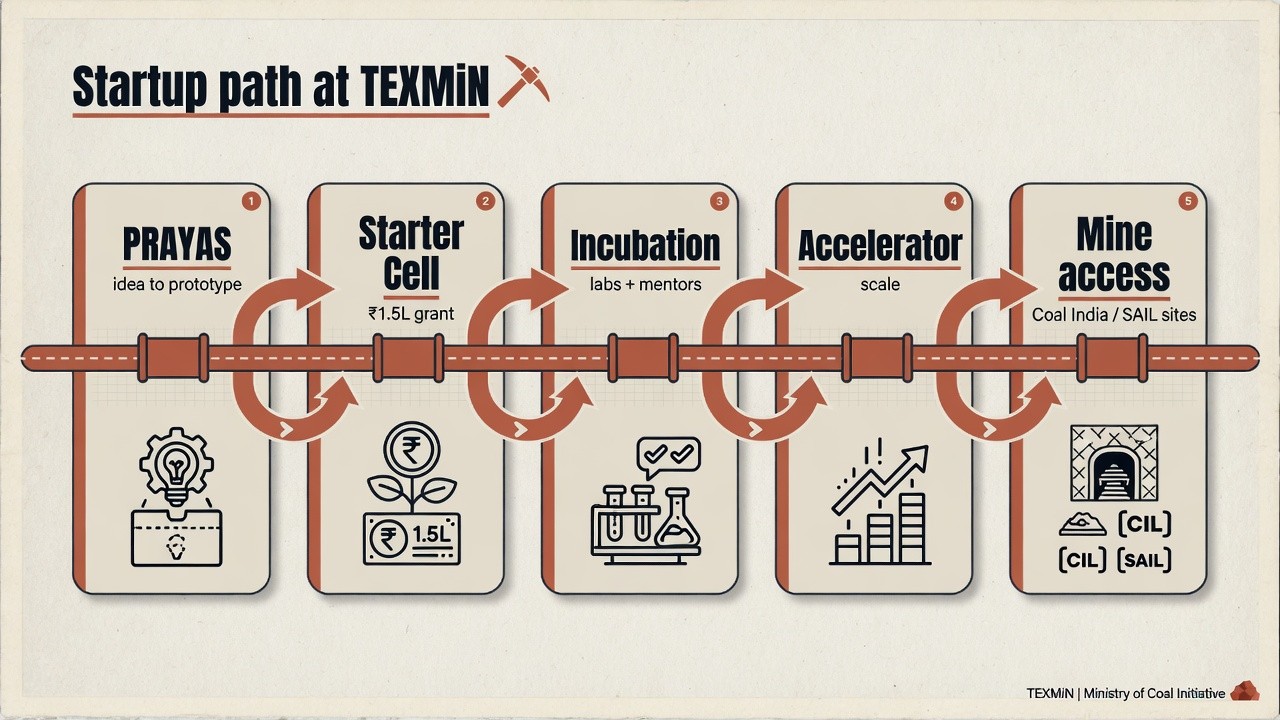
You can build mining AI in Bangalore. You cannot test it in a real coal mine in Bangalore.
From TIH to TTRP: what changed
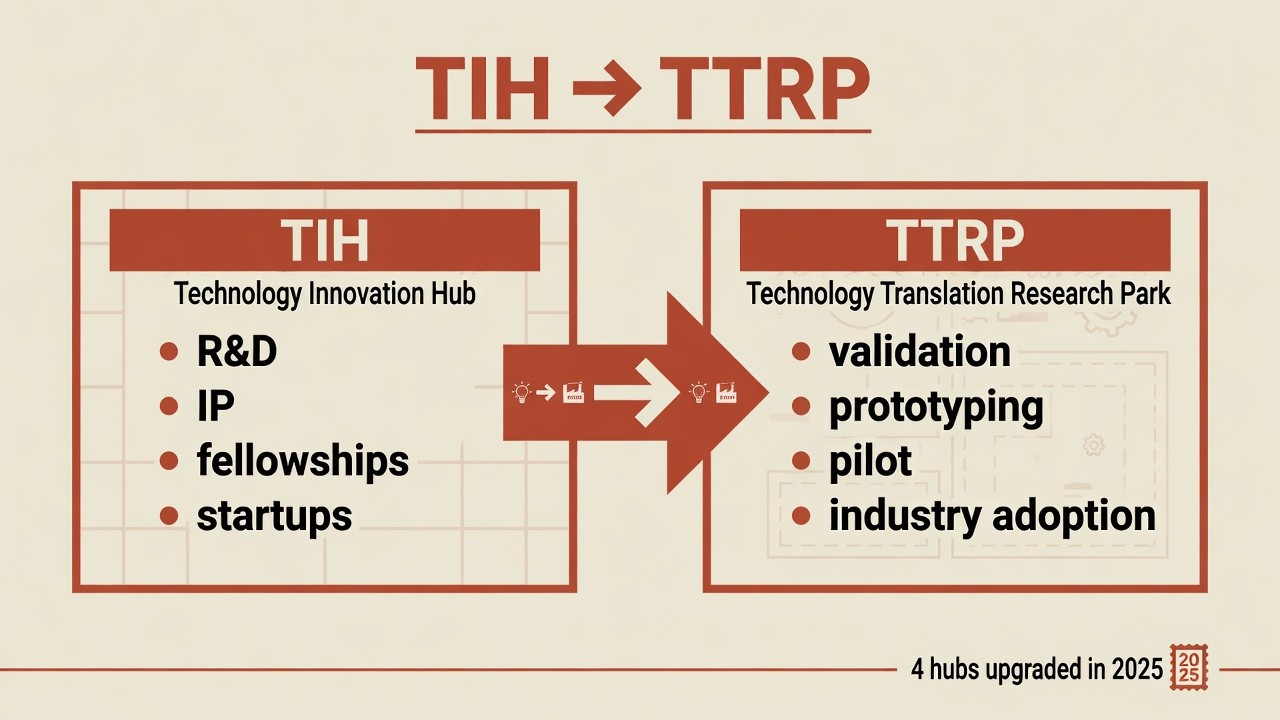
In 2025, DST ran a third-party evaluation of all 25 TIHs. Four got upgraded to Technology Translation Research Parks. IISc Bangalore for robotics and AI systems. IIT Kanpur for cybersecurity. IIT (ISM) Dhanbad for mining. IIT Indore for digital healthcare.
A TTRP is expected to take research that worked in the lab and push it through validation, prototyping, pilot deployment, and into industry adoption. The funding shifts to match: IIT Indore's TTRP alone has a proposed ₹250 crore investment. TEXMiN's own note on the upgrade: texmin.in coverage.
Where this fits in the bigger picture
They're one layer of a pipeline that starts in schools and ends with defence contracts.
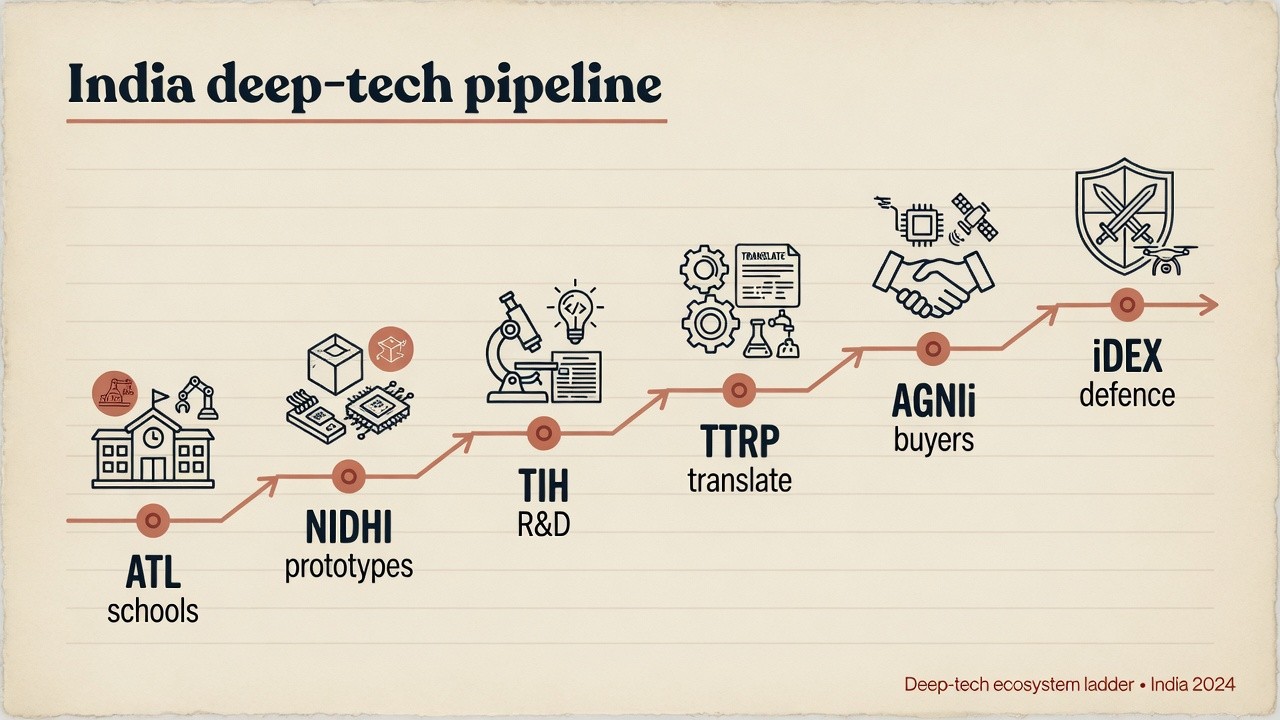
Atal Tinkering Labs put basic electronics and programming into 10,000 schools. NIDHI (another DST program) funds prototypes and incubators for early-stage founders. TIHs handle the R&D layer: technology development, IP creation, specialized talent. TTRPs handle translation: taking that IP to market. AGNIi, under the Principal Scientific Adviser's office, connects mature startups with government and industry buyers. iDEX does the same for defence.
Coordination is messy at this scale, but the skeleton is there, and it's more coherent than it looks from outside.
Who this is for
Engineering student and "mining" sounds boring? The mining industry is being force-fed AI, IoT, and automation right now, and people who know both the domain and the technology are rare enough to name their price. TEXMiN has fellowships: apply via texmin.in.
Researcher with an idea that needs field testing? The Call for Innovation at TEXMiN funds up to ₹2 crore, and the same pattern repeats across most TIHs. Your institute doesn't need to be an IIT: external researchers and DIPP-registered startups can apply.
Startup in a deep-tech vertical? Check which TIH covers your domain on the NM-ICPS TIH list. Most run incubation programs with infrastructure you can't afford on your own, and the Section 8 structure means they're not extracting equity the way a VC would.
And if you just want the summary: ₹3,660 crore committed. Twenty-five hubs running. Four already upgraded to translation parks. It's operational. Primary dashboards: nmicps.gov.in and texmin.in.
I worked at TEXMiN in 2025. Core hub facts: NM-ICPS, PIB, DST, TEXMiN. Industry 4.0 / manufacturing context also draws on MHI SAMARTH, IFR robotics releases, named private-5G plant reports (Airtel/Bosch, Mahindra), and NITI advanced manufacturing roadmap (2025). Facility photos are not reproduced here. Infographics are original.